MetaboInsight Spotlight: Samuele Sala
This month, we spoke one of our ANZ metabolomics community members, Dr Samuele Sala! Dr Sala is an associate lecturer, chemist and early-career researcher with the Centre for Computational and Systems Medicine at Murdoch University (WA). He has expertise in organic and analytical chemistry, with an interest in applying advanced analytical techniques and organic chemical theory to problems in the biological sciences.
Read Sam’s MetaboInsight interviews below to learn more about his work, perspectives and contributions.
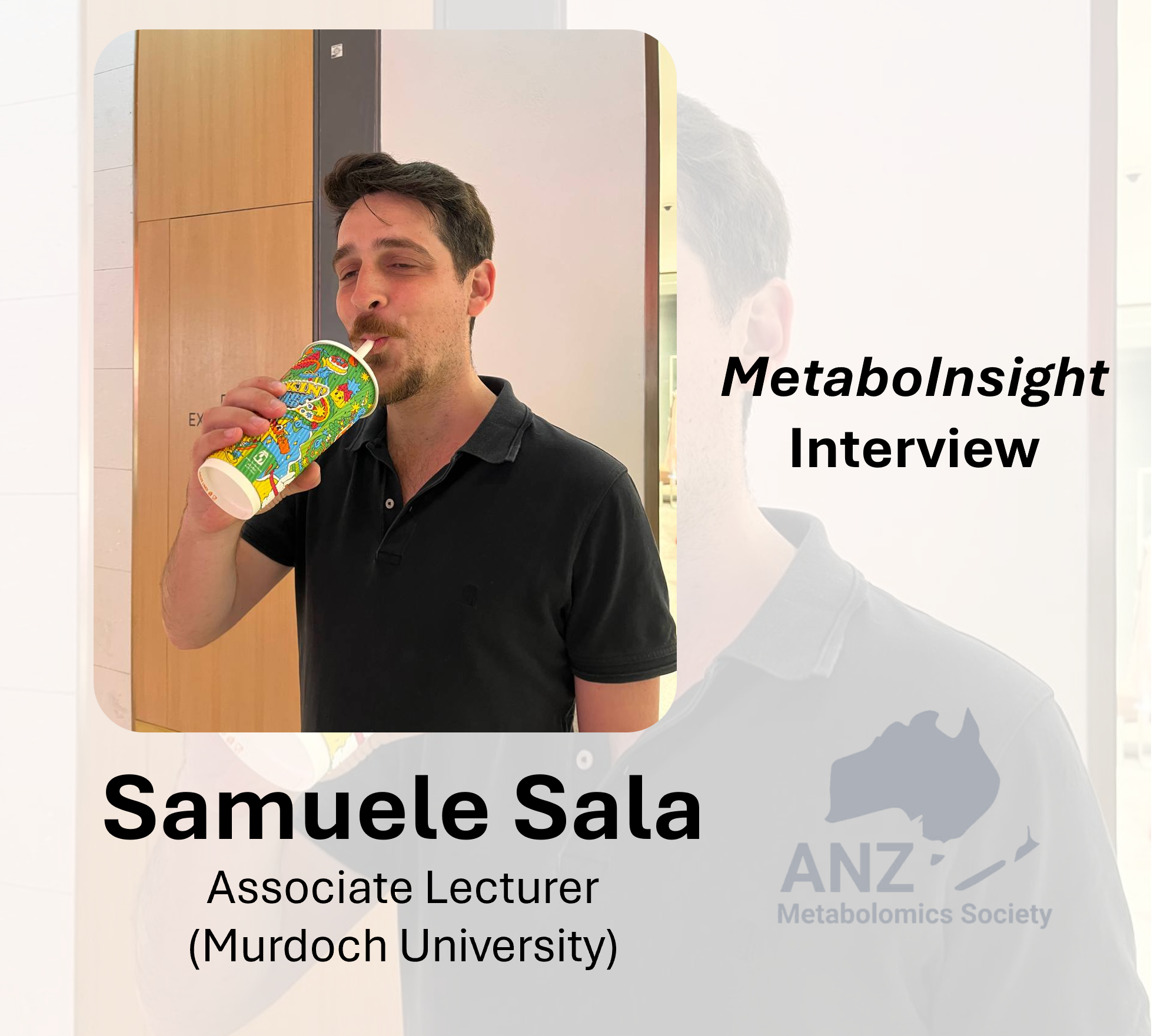
Dr Samuele Sala | Photograph of Sam enjoying a boost juice purchased by his wife.
What originally drew you to metabolomics and analytical chemistry?
My two academic interests are sea-sponges and urine, so in a certain sense you could describe the past 10 years of my life as putting things that stink into expensive magnets. Perhaps surprisingly to my 15-year-old self, this has been an intellectually rewarding career.
On the whole, my trajectory getting to where I am now was quite wonky. When I first got out of high-school I had half an idea of trying to get into medicine, my undergraduate bid to this effect was unsuccessful. My aptitude in high school had been for maths and physics, so with this in mind, I decided that chemistry was probably one of the pre-med streams that I would enjoy more. After about 3 months of undergrad, I concluded that the physical sciences were more of an interest to me than the health sciences, for which I had absolutely no gift, and as such, I ended out completing an undergraduate degree in synthetic organic chemistry. This led on to an honours project in isolation and structural elucidation of secondary metabolites from sea sponges, which at the time I really enjoyed: in particular, the discovery of my first novel compound, which I named albanitrile A (after the city of Albany: close to where the producing sea sponge was first collected, and the nitrile moieties present on the compound). This project subsequently led on to a doctorate, conducted in the same laboratory at UWA.
As my PhD stipend was coming to an end in late 2021, I made it known to my supervisor at the time that I probably wouldn’t be able to conduct any chemistry pro-bono, and that I would have to start looking for work. As luck would have it, around about that time, Prof. Elaine Holmes at Murdoch university was looking for a post-doc with experience in NMR, which I happened to have a little of. Incidentally, the original job description specified bioinformatics expertise, of which I had none. Fortunately, as no one could enter into Western Australia at the that point due to COVID restrictions, I managed to get the Job.
At the moment, I’ve been with Murdoch university for almost 5 years. What has interested me about metabolomics has been the untargeted space, particularly the idea of the unannotated “dark metabolome”, and the structural elucidation challenges that come along with this. The idea that there remains an enormous amount of chemical space that we can’t put a name to, either because the features are instrumental or analytical artifacts, or not represented in databases, or completely novel compounds is a pretty rewarding intellectual challenge, and one that I find gets me out of bed in the morning.
Your research spans NMR and MS-based metabolomics. How do you see these technologies complementing each other in modern phenomics research?
NMR and MS both have their own strengths and weaknesses. I’ve found that a lot of researchers familiar with one technique will often find themselves intimidated by the other. This really shouldn’t be the case. At a bioinformatic level, the data is complementary, if instead you are planning on elucidating the structures of novel compounds from the metabolic milieu, then being able to interpret data from both platforms is indispensable.
What is one analytical challenge in metabolomics that you think the field still underestimates?
Obviously, given my interest in small molecule structural elucidation, my answer is going to be in that direction. This is two-fold, in the sense that, elucidating a completely novel chemical entity is always going to present a significant intellectual challenge, but also that relying on software for automated metabolite annotations is going to be fraught. The untargeted LC-MS literature is full of dubious annotations, even in reputable journals, and there is starting to be pretty significant push back on that front. On the other hand, NMR, which people typically consider to be more robust as far as it’s propensity to afford correct metabolite annotations, can also have methodological pit-falls. In a recent paper we showed that for a particular urinary metabolite, phenylacetylglutamine, NMR based reports got the assignment incorrect over half the time (approx.. 80 total incorrect reports!). On the other hand, I don’t think there is any particularly simple solution to this problem, beyond scrutinising automated metabolite identifications more critically, and trying to cast these through a biochemical lens, i.e. asking the questions: “do these annotations make biochemical sense?”, or more specifically “does it make sense for a natural product that has only ever been reported in sea cucumbers to come up as a discriminating feature when looking at individual with arthritis vs healthy controls? Etc…”.
You’ve worked on natural products and marine-derived metabolites. What makes sea sponges such fascinating organisms for metabolomics research? Are there unique analytical challenges when studying marine sponge chemistry?
The chemistry of sea sponges is sublime. Beautiful compounds. If any of the readers are inclined to look up chemical structures, I encourage them to look up the structures of manzamine A, polytheonamide, or the spongistatins. Prof. Mary Garson of UQ, (now president of IUPAC) once gave a lecture where she described sponges as “the petri-dish of the ocean”. This sentiment is probably accurate, in the sense that a significant portion of compounds in sea sponges (but not all!) are made by symbiotic bacteria. I remember reading a paper that mentioned that typically, approx. 40% of the biomass within a marine sponge is bacterial. I don’t know if this holds true across all taxa, but it’s probably close enough. Finally, sea sponges are evolutionarily ancient, and some of these symbiotic relationships go back multiple hundreds of millions of years, so the organisms and their symbionts are often tightly coupled.
A big challenge when conducting the research is being able to amass enough purified compound in order to obtain suitable heteronuclear NMR spectra. This can be multiple months of work. Also, if the sample was from 1.0 km below sea level, and the sea sponge runs out, that’s it, you likely won’t be getting any more of it. If you compare structure elucidation in natural products chemistry to metabolite identification in metabolomics, the structures of individual compounds from sea sponges are generally far more complicated than the features one has to annotate in an untargeted metabolomic investigation, but, the compounds are pure. In this regard, the intellectual challenge is generally of similar difficulty.
What advice would you give to early-career researchers entering the metabolomics field?
Regarding advice for research, I’ll quote from my old PhD supervisor, A. Prof Gavin (Gav) Flematti, “a day in the library can be worth a month in the lab”. In general, I think PhD students should spend more time reading. Both about their chosen field of investigation, and more broadly. As you progress further along, that time to “read for fun” becomes increasingly rare. So, take advantage of it while you can, because it will serve you in good stead to understand more about the state-of-the-art within the field, and science in general.
As far as professional advice is concerned, between poor job security and near constant rejection, working in academic research can be pretty exhausting. To this end, enjoy the small wins, whether it’s a paper being accepted, or an interesting discovery in the lab. If you don’t make time to enjoy these, the rest of the work can get pretty miserable.
Finally, as far as personal advice goes: I’ll share a quote that I read some time ago, that itself was advice a PhD student received from her supervisor when starting in academia: "Everyone here is smart, distinguish yourself by being kind."
Thank you Sam for sharing your wonderfully honest and engaging story from sea sponges to urine, and from synthetic chemistry to the dark metabolome. It’s been a pleasure hearing how curiosity and persistence shaped your path! If you are interested in Sam's work, check out his newly published work “Clathriamine A, an Antibacterial Dimeric Araiosamine Homologue from a Marine Sponge Clathria (Thalysias) sp.” DOI: 10.1021/acs.joc.5c02852
Brought to you by the EMCR subcommittee